Download the free tracker
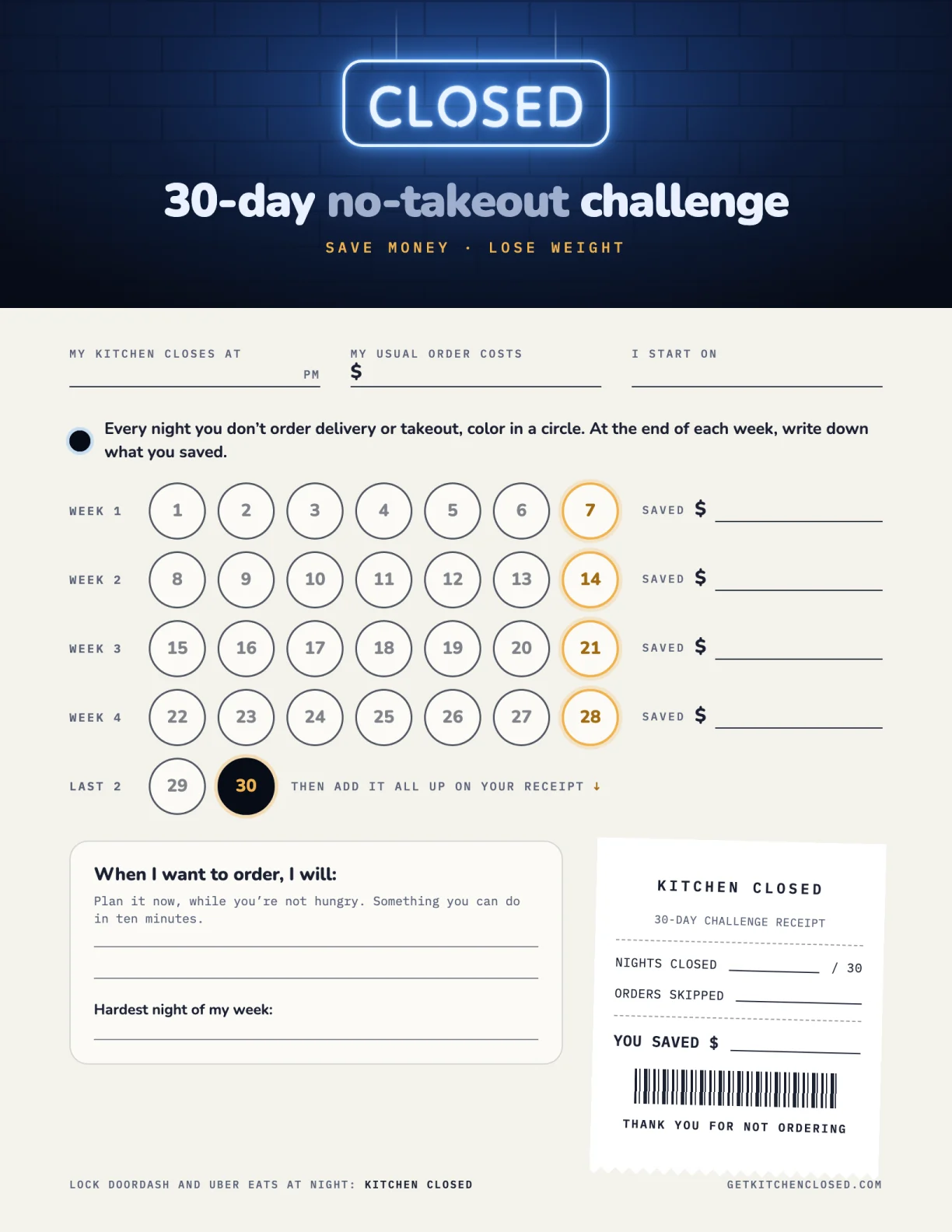
One page, US Letter, made to print at home. Color in a circle for every night you don’t order, write what you saved at the end of each week, and add it all up on the receipt at the bottom.
The rules
It’s a no-spend challenge for one thing only: a no-spend month cuts all spending you don’t need, and this cuts delivery and takeout.
- No delivery and no takeout for 30 days. That means DoorDash, Uber Eats, Grubhub, drive-thrus and pickup orders. Groceries are fine.
- Set the time your kitchen closes, for example 9 PM. After that, no ordering at all. If you mostly order late, this is the rule that matters most.
- Color in a circle for every night you don’t order. At the end of each week, write down what you saved: your usual order, times the orders you skipped.
- Decide your exceptions now. A birthday dinner or a work lunch can be in or out, but decide before you start, not when you’re hungry.
- Plan the nights you’ll want to order. Write down what you’ll do instead, as an if-then plan: “When I want to order, I’ll make toast and eggs.” Plans like this make you more likely to follow through.
- If you slip, keep going. One order doesn’t end the challenge: missing one night doesn’t undo the habit. Leave that circle empty and carry on the next night.
How much you could save in 30 days
Multiply your usual order by how often you order. Over 30 days:
| Usual order | 2 a week | 3 a week | 5 a week |
|---|---|---|---|
| $20 | $171 | $257 | $429 |
| $30 | $257 | $386 | $643 |
| $40 | $343 | $514 | $857 |
Kept up for a year, three $30 orders a week come to $4,680.
Make the 30 days easier
- Start on a Monday or the 1st. People are more likely to start a goal at the beginning of a week, a month or a year, and a clean start makes the tracker easy to follow.
- Remove your saved cards from DoorDash and Uber Eats, so every order means finding your wallet. Here’s how on DoorDash.
- Lock the apps at night. Kitchen Closed locks DoorDash, Uber Eats and other delivery apps at the time your kitchen closes.
- Keep something easy to eat at home, for the nights you get home late and hungry. How to stop eating at night has more on those nights.
- Tell someone you’re doing it, or do it together. It’s harder to order when someone’s going to ask how it’s going.
After 30 days
Add up your receipt, then keep the rules that worked. Thirty days is a start: new habits usually take about two months to stick. If late nights were the hard part, keep your kitchen closing time, and keep the apps locked after it.
Sources
- Gollwitzer & Sheeran (2006): Implementation intentions and goal achievement, a meta-analysis
- Lally et al. (2010), European Journal of Social Psychology: how habits are formed
- Singh et al. (2024): Time to form a habit, a systematic review and meta-analysis of health behaviour habit formation
- Dai, Milkman & Riis (2014): The fresh start effect
Prices and steps checked on October 19, 2026.